Who dated Alexander Vasilchikov?
Catherine II of Russia dated Alexander Vasilchikov from ? until ?.
Alexander Vasilchikov
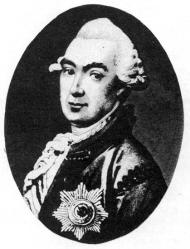
Alexander Semyonovich Vasilchikov (Russian: Александр Семёнович Васильчиков, tr. Aleksandr Semënovič Vasil'čikov; 1746–1813) was a Russian aristocrat who became the lover of Catherine the Great from 1772 to 1774.
Vasilchikov was an ensign in the Chevalier Guard Regiment when he was noted by Catherine and was appointed gentleman of the bedchamber on 1 August 1772. When Catherine's then-lover Grigory Grigoryevich Orlov left court, Catherine was informed about his adultery, and 12 August, Vasilchikov was made general aide-de-camp and lover of Catherine. Vasilchikov was expected to be available to attend on her at all times, and was not allowed to leave the palace without permission.
The relationship was short-lived. Catherine found Vasilchikov's gentleness cloying, saying "His tenderness made me weep." When Vasilchikov was away on a journey, sent by the empress, Grigory Potemkin replaced him as her lover. She wrote to her friend Friedrich Melchior, Baron von Grimm about Vasilchikov's dismissal: "Why do you reproach me because I dismiss a well-meaning but extremely boring bourgeois in favour of one of the greatest, the most comical and amusing, characters of this iron century?"
Vasilchikov later complained that he felt like a hired gigolo: "I was nothing more to her than a kind of male cocotte and I was treated as such. If I made a request for myself or anyone else, she did not reply, but the next day I found a bank-note for several thousand rubles in my pocket. She never condescended to discuss with me any matters that lay close to my heart."
Catherine characteristically rewarded her former lover richly. Vasilchikov was given a pension of twenty thousand rubles and valuable properties. He lived the rest of his life in Moscow. He never married. He built a notable collection of Western European paintings and sculptures, including a "Self Portrait" by Velasquez and works by Philips Wouwerman and Andries Botha.
Read more...Catherine II of Russia
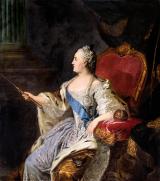
Catherine II (born Princess Sophia Augusta Frederica of Anhalt-Zerbst; 2 May 1729 – 17 November 1796), commonly known as Catherine the Great, was the reigning Empress of Russia from 1762 to 1796. She came to power after a coup d'etat against her husband, Peter III. Her long reign helped Russia thrive under a golden age during the Enlightenment. This renaissance led to the founding of many new cities, universities, and theatres, along with large-scale immigration from the rest of Europe and the recognition of Russia as one of the great powers of Europe.
After overthrowing and possibly assassinating her husband and her subsequent rule of the Russian Empire, Catherine often relied on noble favourites such as Count Grigory Orlov and Grigory Potemkin. Assisted by highly successful generals such as Alexander Suvorov and Pyotr Rumyantsev and admirals such as Samuel Greig and Fyodor Ushakov, she governed at a time when the Russian Empire was expanding rapidly by conquest and diplomacy. In the west, she installed her former lover to the throne of Poland, which was eventually partitioned. In the south, the Crimean Khanate was annexed following victories over the Bar Confederation and the Ottoman Empire in the Russo-Turkish War. With the support of Great Britain, Russia colonised the territories of New Russia along the coasts of the Black and Azov seas. In the east, Russians became the first Europeans to colonise Alaska, establishing Russian America.
Many cities and towns were founded on Catherine's orders in the newly conquered lands, most notably Yekaterinoslav, Kherson, Nikolayev, and Sevastopol. An admirer of Peter the Great, Catherine continued to modernise Russia along Western European culture. However, military conscription and the economy continued to depend on serfdom, and the increasing demands of the state and of private landowners intensified the exploitation of serf labour. This was one of the chief reasons behind rebellions, including Pugachev's Rebellion of Cossacks, nomads, peoples of the Volga, and peasants.
The Manifesto on Freedom of the Nobility, issued during the short reign of Peter III and confirmed by Catherine, freed Russian nobles from compulsory military or state service. The construction of many mansions of the nobility in the classical style endorsed by the empress changed the face of the country. She is often included in the ranks of the enlightened despots. Catherine presided over the age of the Russian Enlightenment and established the Smolny Institute of Noble Maidens, the first state-financed higher education institution for women in Europe.
Read more...