Who dated Fotini Mauromixali?
Otto of Greece dated Fotini Mauromixali from ? until ?.
Fotini Mauromixali
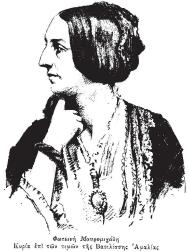
Fotini Mavromichali (Greek: Φωτεινή Μαυρομιχάλη; 1826–1878), was a Greek court office holder and royal mistress.
She was the granddaughter of Petrobey Mavromichalis. She was acquainted with Sophie de Marbois-Lebrun, Duchess of Plaisance, who taught her French and French etiquette.
In 1844 she became the lady-in-waiting (dame d'honneur ) of the queen of Greece, Amalia of Oldenburg after Katerina Botsari, who retired from court service that year. Fotini Mavromichali was described as a beauty, and became a popular figure at the court. She accompanied the queen on her visit to Berlin in 1849.
She is described as the only confirmed extramarital love affair of king Otto of Greece, an affair that resulted in her dismissal and a conflict between the Mavromichalis family and the queen.
Read more...Otto of Greece

Otto (Greek: Όθων, romanized: Óthon; German: Otto Friedrich Ludwig von Wittelsbach; 1 June 1815 – 26 July 1867) was King of Greece from the establishment of the Kingdom of Greece on 7 May 1832, under the Convention of London, until he was deposed in October 1862.
The second son of King Ludwig I of Bavaria, Otto ascended the newly created throne of Greece at age 17. His government was initially run by a three-man regency council made up of Bavarian court officials. Upon reaching his majority, Otto removed the regents when they proved unpopular with the people, and he ruled as an absolute monarch. Eventually, his subjects' demands for a constitution proved overwhelming, and in the face of an armed (but bloodless) insurrection, Otto granted a constitution in 1843.
Throughout his reign, Otto tried to make significant reforms to modernize Greece, seeing himself as an Enlightened absolutist. He established educational institutions and several state services but was unable to resolve Greece's major poverty and prevent economic meddling from outside. Greek politics in this era were based on affiliations with the three Great Powers that had guaranteed Greece's independence, Britain, France and Russia, and Otto's ability to maintain the support of these powers was key to his remaining in power. To remain strong, Otto had to play the interests of each of the Great Powers' Greek adherents against the others, while not irritating the Great Powers. When Greece was blockaded by the British Royal Navy in 1850 and again in 1854, to stop Greece from attacking the Ottoman Empire during the Crimean War, Otto's standing amongst Greeks suffered. As a result, there was an assassination attempt on Queen Amalia, and finally, in October 1862, Otto was deposed while in the countryside. He died in exile in Bavaria in 1867.
Read more...