Who dated Anne Louise Germaine de Staël?
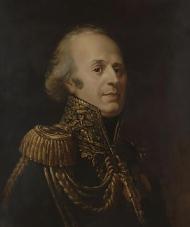
Louis, comte de Narbonne-Lara dated Anne Louise Germaine de Staël from ? until ?. The age gap was 11 years, 1 months and 2 days.
Benjamin Constant dated Anne Louise Germaine de Staël from ? until ?. The age gap was 1 years, 6 months and 3 days.
Charles-Maurice de Talleyrand-Périgord dated Anne Louise Germaine de Staël from ? until ?. The age gap was 12 years, 2 months and 20 days.
Anne Louise Germaine de Staël
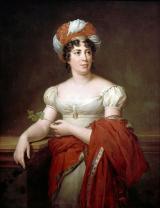
Anne Louise Germaine de Staël-Holstein (French: [an lwiz ʒɛʁmɛn də stal ɔlstajn]; born Anne Louise Germaine Necker; 22 April 1766 – 14 July 1817), commonly known as Madame de Staël ( də-STAHL; French: [madam də stal]), was a prominent French novelist, woman of letters, philosopher, and political theorist in both Parisian and Genevan intellectual circles. She was the daughter of banker and French finance minister Jacques Necker and Suzanne Curchod, a respected salonist and writer. Throughout her life, she held a moderate stance during the tumultuous periods of the French Revolution and the Napoleonic era, persisting until the time of the French Restoration.
Her presence at critical events such as the Estates General of 1789 and the 1789 Declaration of the Rights of Man and of the Citizen underscored her engagement in the political discourse of her time. However, Madame de Staël faced exile for extended periods: initially during the Reign of Terror and subsequently due to personal persecution by Napoleon. She claimed to have discerned the tyrannical nature and ambitions of his rule ahead of many others.
During her exile, she fostered the Coppet group, a network that spanned across Europe, positioning herself at its heart. Her literary works, emphasizing individuality and passion, left an enduring imprint on European intellectual thought. De Staël's repeated championing of Romanticism contributed significantly to its widespread recognition.
Within her work, de Staël not only advocates for the necessity of public expression but also sounds cautionary notes about its potential hazards.
Read more...Louis, comte de Narbonne-Lara
Anne Louise Germaine de Staël
Benjamin Constant
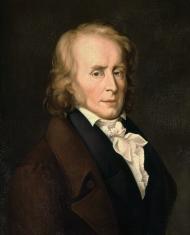
Henri-Benjamin Constant de Rebecque (25 October 1767 – 8 December 1830), or simply Benjamin Constant, was a Swiss and French political thinker, activist and writer on political theory and religion.
A committed republican from 1795, Constant backed the coup d'état of 18 Fructidor (4 September 1797) and the following one on 18 Brumaire (9 November 1799). He became the leader of the Liberal opposition in 1800, during the Consulate. Having upset Napoleon and left France to go to Switzerland then to the Kingdom of Saxony, Constant nonetheless sided with him during the Hundred Days, drafting the Charter of 1815, and became politically active again during the Bourbon Restoration. He was elected to the Chamber of Deputies in 1818 and remained in office until his death in 1830. As the head of the Liberal opposition, known as Indépendants, Constant was one of the most notable orators of the Chamber as a proponent of the parliamentary system. During the July Revolution, he was a supporter of Louis Philippe I ascending the throne.
Besides his numerous essays on political and religious themes, Constant also wrote on romantic love. His autobiographical Le Cahier rouge (1807) gives an account of his love for Madame de Staël, whose protégé and collaborator he became, especially in the Coppet circle, and a successful novella, Adolphe (1816), are good examples of his work on this topic.
Constant was a fervent liberal of the early 19th century. He refined the concept of liberty, defining it as a condition of existence that allowed the individual to turn away interference from the state or society.
Read more...Anne Louise Germaine de Staël
Charles-Maurice de Talleyrand-Périgord
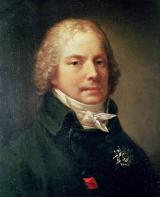
Charles-Maurice de Talleyrand-Périgord (; French: [ʃaʁl mɔʁis də tal(ɛ)ʁɑ̃ peʁiɡɔʁ, moʁ-]; 2 February 1754 – 17 May 1838), 1st Prince of Benevento, then Prince of Talleyrand, was a French secularized clergyman, statesman, and leading diplomat. After studying theology, he became Agent-General of the Clergy in 1780. In 1789, just before the French Revolution, he became Bishop of Autun. He worked at the highest levels of successive French governments, most commonly as foreign minister or in some other diplomatic capacity. He served as the French Diplomat in the Congress of Vienna. His career spanned the regimes of Louis XVI, the years of the French Revolution, Napoleon, Louis XVIII, Charles X, and Louis Philippe I. Those Talleyrand served often distrusted him but found him extremely useful. The name "Talleyrand" has become a byword for crafty and cynical diplomacy.
Talleyrand was Napoleon's chief diplomat during the years when French military victories brought one European state after another under French hegemony. Most of the time, he worked for peace so as to consolidate France's gains. He succeeded in obtaining peace with Austria through the 1801 Treaty of Lunéville and with Britain in the 1802 Treaty of Amiens. He could not prevent the renewal of war in 1803 but by 1805 he opposed his emperor's renewed wars against Austria, Prussia, and Russia. He resigned as foreign minister in August 1807, but retained the trust of Napoleon. He conspired to undermine the emperor's plans through secret dealings with Tsar Alexander I of Russia and the Austrian minister Klemens von Metternich. Talleyrand sought a negotiated secure peace so as to perpetuate the gains of the French Revolution. Napoleon rejected peace; when he fell in 1814, Talleyrand supported the Bourbon Restoration decided by the Allies. He played a major role at the Congress of Vienna in 1814–1815, where he negotiated a favorable settlement for France and played a role in unwinding the Napoleonic Wars.
Talleyrand polarizes opinion. Some regard him as one of the most versatile, skilled, and influential diplomats in European history, while others believe that he was a traitor, betraying in turn the ancien régime, the French Revolution, and Napoleon.
Read more...