Who dated Hernán Cortés?
Isabel Moctezuma dated Hernán Cortés from ? until ?.
La Malinche dated Hernán Cortés from ? until ?.
Hernán Cortés
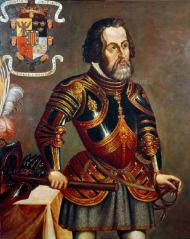
Hernán Cortés de Monroy y Pizarro Altamirano, 1st Marquis of the Valley of Oaxaca (December 1485 – December 2, 1547) was a Spanish conquistador who led an expedition that caused the fall of the Aztec Empire and brought large portions of what is now mainland Mexico under the rule of the King of Castile in the early 16th century. Cortés was part of the generation of Spanish explorers and conquistadors who began the first phase of the Spanish colonization of the Americas.
Born in Medellín, Spain, to a family of lesser nobility, Cortés chose to pursue adventure and riches in the New World. He went to Hispaniola and later to Cuba, where he received an encomienda (the right to the labor of certain subjects). For a short time, he served as alcalde (magistrate) of the second Spanish town founded on the island. In 1519, he was elected captain of the third expedition to the mainland, which he partly funded. His enmity with the governor of Cuba, Diego Velázquez de Cuéllar, resulted in the recall of the expedition at the last moment, an order which Cortés ignored.
Arriving on the continent, Cortés executed a successful strategy of allying with some indigenous people against others. He also used a native woman, Doña Marina, as an interpreter. She later gave birth to his first son. When the governor of Cuba sent emissaries to arrest Cortés, he fought them and won, using the extra troops as reinforcements. Cortés wrote letters directly to the king asking to be acknowledged for his successes instead of being punished for mutiny. After he overthrew the Aztec Empire, Cortés was awarded the title of marqués del Valle de Oaxaca, while the more prestigious title of viceroy was given to a high-ranking nobleman, Antonio de Mendoza. In 1541, Cortés returned to Spain, where he died six years later of natural causes.
Read more...Isabel Moctezuma
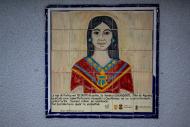
Doña Isabel Moctezuma (born Tecuichpoch Ichcaxochitzin; 1509/1510 – 1550/1551) was a daughter of the Aztec ruler Moctezuma II. She was the consort of Atlixcatzin, a tlacateccatl, and of the Aztec emperors Cuitlahuac and Cuauhtemoc and as such the last Aztec empress. After the Spanish conquest, Doña Isabel was recognized as Moctezuma's legitimate heir, and became one of the indigenous Mexicans granted an encomienda. Among the others were her half-sister Marina (or Leonor) Moctezuma, and Juan Sánchez, an Indian governor in Oaxaca.
Isabel was married to one tlacateccatl, two Aztec emperors and three Spaniards, and widowed five times. She had a daughter out of wedlock whom she refused to recognize, Leonor Cortés Moctezuma, with conquistador Hernán Cortés. Her sons founded a line of Spanish nobility. The title of Duke of Moctezuma de Tultengo descends from her brother, and still exists.
Read more...Hernán Cortés
La Malinche
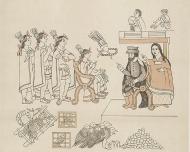
Marina ([maˈɾina]) or Malintzin ([maˈlintsin]; c. 1500 – c. 1529), more popularly known as La Malinche ([la maˈlintʃe]), was a Nahua woman from the Mexican Gulf Coast, who became known for contributing to the Spanish conquest of the Aztec Empire (1519–1521), by acting as an interpreter, advisor, and intermediary for the Spanish conquistador Hernán Cortés. She was one of 20 enslaved women given to the Spaniards in 1519 by the natives of Tabasco. Cortés chose her as a consort, and she later gave birth to their first son, Martín – one of the first Mestizos (people of mixed European and Indigenous American ancestry) in New Spain.
La Malinche's reputation has shifted over the centuries, as various peoples evaluate her role against their own societies' changing social and political perspectives. Especially after the Mexican War of Independence, which led to Mexico's independence from Spain in 1821, dramas, novels, and paintings portrayed her as an evil or scheming temptress. In Mexico today, La Malinche remains a powerful icon – understood in various and often conflicting aspects as the embodiment of treachery, the quintessential victim, or the symbolic mother of the new Mexican people. The term malinchista refers to a disloyal compatriot, especially in Mexico.
Read more...