Who dated Marguerite Hasselmans?
Gabriel Fauré dated Marguerite Hasselmans from ? until ?. The age gap was 31 years, 0 months and 17 days.
Marguerite Hasselmans
Marguerite Hasselmans (* 29. Mai 1876 in Paris; † 13. September 1947 ebenda) war eine französische Pianistin und langjährige Geliebte des Komponisten Gabriel Fauré.
Die Tochter des Harfenisten und Komponisten Alphonse Hasselmans absolvierte eine Ausbildung als Pianistin. 1898 heiratete sie André Tracol, der Geiger im Orchester des Pariser Konservatoriums war. 1900 lernte sie den 31 Jahre älteren Fauré kennen, dessen ständige Begleiterin sie bis zu seinem Tode war. Er richtete ihr ein luxuriöses Appartement in der Rue de Wagram ein, wo sie auch Klavierunterricht gab. Ihre Ehe mit Tracol wurde noch im selben Jahr geschieden.
Hasselmans war eine geschätzte Pianistin und auch mit Paul Dukas und Isaac Albéniz befreundet. Während ihr Fauré nie ein Werk widmete, widmete ihr Albéniz das dritte Buch seiner Iberia. Bei einem Konzert mit der Societé des Concerts Hasselmans unter Leitung ihres Bruders Louis Hasselmans spielte sie 1902 Mozarts Klavierkonzert c-moll mit einer Kadenz, die Fauré eigens für sie komponiert hatte. 1919 spielte sie in Monte Carlo die Uraufführung von dessen Fantaisie (op. 111).
Nach dem Tod Faurés ehrte ihn Hasselmans mit einer Reihe von Kammermusikkonzerten. Sie förderte auch die Gründung des Société fauréenne 1938 durch dessen Sohn Philippe Fauré-Fremiet und E. de Stoecklin. Ein Projekt für ein Buch zur Interpretation der Klaviermusik Faurés mit Philippe Fauré-Fremiet wurde nicht verwirklicht.
Read more...Gabriel Fauré
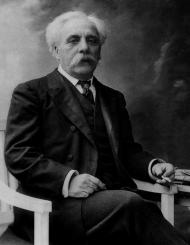
Gabriel Urbain Fauré (12 May 1845 – 4 November 1924) was a French composer, organist, pianist and teacher. He was one of the foremost French composers of his generation, and his musical style influenced many 20th-century composers. Among his best-known works are his Pavane, Requiem, Sicilienne, nocturnes for piano and the songs "Après un rêve" and "Clair de lune". Although his best-known and most accessible compositions are generally his earlier ones, Fauré composed many of his most highly regarded works in his later years, in a more harmonically and melodically complex style.
Fauré was born into a cultured but not especially musical family. His talent became clear when he was a young boy. At the age of nine, he was sent to the École Niedermeyer music college in Paris, where he was trained to be a church organist and choirmaster. Among his teachers was Camille Saint-Saëns, who became a lifelong friend. After graduating from the college in 1865, Fauré earned a modest living as an organist and teacher, leaving him little time for composition. When he became successful in his middle age, holding the important posts of organist of the Église de la Madeleine and director of the Paris Conservatoire, he still lacked time for composing; he retreated to the countryside in the summer holidays to concentrate on composition. By his last years, he was recognised in France as the leading French composer of his day. An unprecedented national musical tribute was held for him in Paris in 1922, headed by the president of the French Republic. Outside France, Fauré's music took decades to become widely accepted, except in Britain, where he had many admirers during his lifetime.
Fauré's music has been described as linking the end of Romanticism with the modernism of the second quarter of the 20th century. When he was born, Chopin was still composing, and by the time of Fauré's death, jazz and the atonal music of the Second Viennese School were being heard. The Grove Dictionary of Music and Musicians, which describes him as the most advanced composer of his generation in France, notes that his harmonic and melodic innovations influenced the teaching of harmony for later generations. During the last twenty years of his life, he suffered from increasing deafness. In contrast with the charm of his earlier music, his works from this period are sometimes elusive and withdrawn in character, and at other times turbulent and impassioned.
Read more...