Who dated Maria Ivanova Katatcharova?
Nicholas I of Russia dated Maria Ivanova Katatcharova from ? until ?.
Alexander I of Russia dated Maria Ivanova Katatcharova from ? until ?.
Maria Ivanova Katatcharova
Nicholas I of Russia
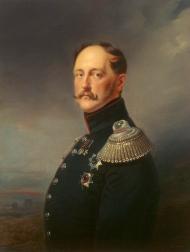
Nicholas I (6 July [O.S. 25 June] 1796 – 2 March [O.S. 18 February] 1855) was Emperor of Russia, King of Congress Poland, and Grand Duke of Finland from 1825 to 1855. He was the third son of Paul I and younger brother of his predecessor, Alexander I. Nicholas's thirty-year reign began with the failed Decembrist revolt. He is mainly remembered as a reactionary whose controversial reign was marked by geographical expansion, centralisation of administrative policies, and repression of dissent both in Russia and among its neighbors. Nicholas had a happy marriage that produced a large family, with all of their seven children surviving childhood.
Nicholas's biographer Nicholas V. Riasanovsky said that he displayed determination, singleness of purpose, and an iron will, along with a powerful sense of duty and a dedication to very hard work. He saw himself as a soldier—a junior officer consumed by spit and polish. A handsome man, he was highly nervous and aggressive. Trained as a military engineer, he was a stickler for minute detail. In his public persona, stated Riasanovsky, "Nicholas I came to represent autocracy personified: infinitely majestic, determined and powerful, hard as stone, and relentless as fate."
Nicholas I was instrumental in helping to create an independent Greek state and resumed the Russian conquest of the Caucasus by seizing Iğdır Province and the remainder of modern-day Armenia and Azerbaijan from Qajar Iran during the Russo-Persian War (1826–1828). He ended the Russo-Turkish War (1828–1829) successfully as well. He crushed the November Uprising in Poland in 1831 and decisively aided Austria during the Hungarian Revolution of 1848. Later on, however, he led Russia into the Crimean War (1853–1856), with disastrous results. Historians emphasize that his micromanagement of the armies hindered his generals, as did his misguided strategy. Several historians have concluded that "the reign of Nicholas I was a catastrophic failure in both domestic and foreign policy." On the eve of his death, the Russian Empire spanned over 20 million square kilometers (7.7 million square miles), but had a desperate need for reform.
Read more...Maria Ivanova Katatcharova
Alexander I of Russia
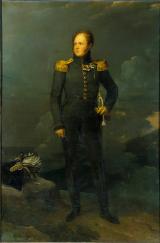
Alexander I (Russian: Александр I Павлович, romanized: Aleksandr I Pavlovich, IPA: [ɐlʲɪkˈsandr ˈpavləvʲɪtɕ]; 23 December [O.S. 12 December] 1777 – 1 December [O.S. 19 November] 1825), nicknamed "the Blessed", was Emperor of Russia from 1801, the first king of Congress Poland from 1815, and the grand duke of Finland from 1809 to his death in 1825. He ruled Russia during the chaotic period of the Napoleonic Wars.
The eldest son of Emperor Paul I and Sophie Dorothea of Württemberg, Alexander succeeded to the throne after his father was murdered. As prince and during the early years of his reign, he often used liberal rhetoric but continued Russia's absolutist policies in practice. In the first years of his reign, he initiated some minor social reforms and (in 1803–04) major liberal educational reforms, such as building more universities. Alexander appointed Mikhail Speransky, the son of a village priest, as one of his closest advisors. The over-centralized Collegium ministries were abolished and replaced by the Committee of Ministers, State Council, and Supreme Court to improve the legal system. Plans were made, but never consummated, to set up a parliament and sign a constitution. In contrast to his westernizing predecessors such as Peter the Great, Alexander was a Russian nationalist and Slavophile who wanted Russia to develop on the basis of Russian rather than European culture.
In foreign policy, he changed Russia's position towards France four times between 1804 and 1812, shifting among neutrality, opposition, and alliance. In 1805 he joined Britain in the War of the Third Coalition against Napoleon, but after suffering massive defeats at the battles of Austerlitz and Friedland, he switched sides and formed an alliance with Napoleon in the Treaty of Tilsit (1807) and joined Napoleon's Continental System. He fought a small-scale naval war against Britain between 1807 and 1812 and took Finland from Sweden in 1809 after Sweden's refusal to join the Continental System. Alexander and Napoleon hardly agreed, especially regarding Poland, and the alliance collapsed by 1810. Alexander's greatest triumph came in 1812 when Napoleon's invasion of Russia descended into a catastrophe for the French. As part of the winning coalition against Napoleon, he gained territory in Poland. He formed the Holy Alliance to suppress the revolutionary movements in Europe, which he saw as immoral threats to legitimate Christian monarchs.
During the second half of his reign, Alexander became increasingly arbitrary, reactionary, and fearful of plots against him; as a result, he ended many of the reforms he had made earlier on in his reign. He purged schools of foreign teachers, as education became more religiously driven as well as politically conservative. Speransky was replaced as advisor with the strict artillery inspector Aleksey Arakcheyev, who oversaw the creation of military settlements. Alexander died of typhus in December 1825 while on a trip to southern Russia. He left no legitimate children, as his two daughters died in childhood. Neither of his brothers wanted to become emperor. After a period of great confusion (that presaged the failed Decembrist revolt of liberal army officers in the weeks after his death), he was succeeded by his younger brother, Nicholas I.
Read more...