Who dated Marianne Koberwein?
Nicholas I of Russia dated Marianne Koberwein from ? until ?. The age gap was 4 years, 6 months and 21 days.
Marianne Koberwein
Anna Maria "Marianne" Charlotta Koberwein née Rutenskiöld (Stockholm, 15 December 1791 - Pushkin, Saint Petersburg, August 2, 1856) was a Swedish and later Russian Empire courtier. She is known for her affair with Nicholas I of Russia.
She was the daughter of the Swedish nobleman Gustavus Adolphus Rutenskiöld (1758-1802) and daughter of a operasinger, cavalry quartermaster, actress Ulrika Charlotta Stenborg (b. 1772). She served as a lady-in-waiting to the Swedish queen Frederica of Baden, who was married to Gustav IV Adolf of Sweden, and when Gustav IV Adolf was deposed in 1809, she continued her service to Frederica in Karlsruhe.
She was subsequently employed by Frederica's sister Elizabeth Alexeievna (Louise of Baden), empress of Russia. At the Russian court, she became acquainted with, then heir presumptive and married, Nicholas I of Russia, with whom she had a daughter, Joséphine Youzia Koberwein (1825–1893): in parallel, she married in 1820's (Joseph) Vassiliévitch Koberwein (1789-1854), from whom she divorced soon after.
Joséphine Youzia Koberwein was born on May 12, 1825, in the Smolensk province. Officially, Yuziya is the daughter of Joseph Vasilyevich (Osip Ventseslavovich) Koberwein, an undercover police agent. On January 3, 1849, she married the painter Joseph Fricero in Marseille. Just like him, she was engaged in painting. They had four sons: Alexander (1850-1904), Nikolai (1853-1884), Michael (1858-1914) and Emmanuel (1861-1880), whose descendants still live in Nice. She died on February 23, 1893, in Nice. She was buried in the Fricero family grave in the Russian cemetery in Nice.
Read more...Nicholas I of Russia
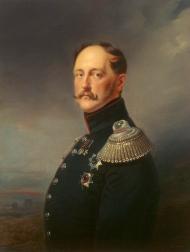
Nicholas I (6 July [O.S. 25 June] 1796 – 2 March [O.S. 18 February] 1855) was Emperor of Russia, King of Congress Poland, and Grand Duke of Finland from 1825 to 1855. He was the third son of Paul I and younger brother of his predecessor, Alexander I. Nicholas's thirty-year reign began with the failed Decembrist revolt. He is mainly remembered as a reactionary whose controversial reign was marked by geographical expansion, centralisation of administrative policies, and repression of dissent both in Russia and among its neighbors. Nicholas had a happy marriage that produced a large family, with all of their seven children surviving childhood.
Nicholas's biographer Nicholas V. Riasanovsky said that he displayed determination, singleness of purpose, and an iron will, along with a powerful sense of duty and a dedication to very hard work. He saw himself as a soldier—a junior officer consumed by spit and polish. A handsome man, he was highly nervous and aggressive. Trained as a military engineer, he was a stickler for minute detail. In his public persona, stated Riasanovsky, "Nicholas I came to represent autocracy personified: infinitely majestic, determined and powerful, hard as stone, and relentless as fate."
Nicholas I was instrumental in helping to create an independent Greek state and resumed the Russian conquest of the Caucasus by seizing Iğdır Province and the remainder of modern-day Armenia and Azerbaijan from Qajar Iran during the Russo-Persian War (1826–1828). He ended the Russo-Turkish War (1828–1829) successfully as well. He crushed the November Uprising in Poland in 1831 and decisively aided Austria during the Hungarian Revolution of 1848. Later on, however, he led Russia into the Crimean War (1853–1856), with disastrous results. Historians emphasize that his micromanagement of the armies hindered his generals, as did his misguided strategy. Several historians have concluded that "the reign of Nicholas I was a catastrophic failure in both domestic and foreign policy." On the eve of his death, the Russian Empire spanned over 20 million square kilometers (7.7 million square miles), but had a desperate need for reform.
Read more...