Who dated Bianca Lancia?
Frederick II, Holy Roman Emperor dated Bianca Lancia from ? until ?.
Bianca Lancia
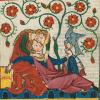
Bianca Lancia d'Agliano (also called Beatrice, c. 1210 – c. 1248), was an Italian noblewoman. She was the mistress and later, possibly the last wife of the Hohenstaufen emperor Frederick II. The marriage was conducted while she was on her deathbed, therefore it was considered non-canonical.
Read more...Frederick II, Holy Roman Emperor
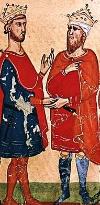
Frederick II (Italian: Federico, Sicilian: Fidiricu, German: Friedrich, Latin: Fridericus; 26 December 1194 – 13 December 1250) was King of Sicily from 1198, King of Germany from 1212, King of Italy and Holy Roman Emperor from 1220, and King of Jerusalem from 1225 to 1228. He was the son of Emperor Henry VI, of the Hohenstaufen dynasty (the second son of Emperor Frederick Barbarossa), and Queen Constance I of Sicily, of the Hauteville dynasty.
Frederick is considered to be one of the most brilliant and powerful figures of the Middle Ages and ruled a vast area, extending from Sicily in the south, through much of Italy, to Germany in the north. Viewing himself as a direct successor to the Roman emperors of antiquity, he was Emperor of the Romans from his papal coronation in 1220 until his death and also a claimant to the title of King of the Romans from 1212 and unopposed holder of that dignity from 1215. As such, he was King of Germany, Italy, and Burgundy. At the age of three, he was crowned King of Sicily as co-ruler with his mother, Constance, Queen of Sicily, the daughter of Roger II of Sicily. His other royal title was King of Jerusalem by virtue of marriage and his connection with the Sixth Crusade. Frequently at war with the papacy, which was hemmed in between Frederick's lands in northern Italy and his Kingdom of Sicily (the Regno) to the south, he was "excommunicated four times between 1227 and his own death in 1250" and was often vilified in pro-papal chronicles of the time and after. Pope Innocent IV went so far as to declare him preambulus Antichristi (forerunner of the Antichrist).
For his many-sided activities, dynamic personality and talents, Frederick II has been called the greatest of all the German emperors, perhaps even of all medieval rulers. In the Kingdom of Sicily and much of Italy, Frederick built upon the work of his Norman predecessors and forged an early absolutist state bound together by an efficient secular bureaucracy. He was known by the appellation Stupor mundi ('Wonder of the World') and maintains a reputation as a Renaissance man avant la lettre and polymath: a visionary statesman, an inspired naturalist, scholar, mathematician, architect, poet and composer. Frederick also reportedly spoke six languages: Latin, Sicilian, Middle High German, Old French, Greek, and Arabic. As an avid patron of science and the arts, he played a major role in promoting literature through the Sicilian School of poetry. His Sicilian imperial-royal court in Palermo, beginning around 1220, was the cultural and intellectual hub of the early 13th century and saw the first use of a literary form of an Italo-Romance language, Sicilian. The poetry that emanated from the school had a significant influence on literature and on what was to become the modern Italian language. He was also the first monarch to formally outlaw trial by ordeal, which had come to be viewed as superstitious.
Though Frederick's line was still in a strong position at the time of his death, it did not survive for long, and the House of Hohenstaufen came to an end. Furthermore, the Holy Roman Empire entered a long period of decline during the Great Interregnum. His complex political and cultural legacy has continued to attract fierce debate and fascination to this day.
Read more...