Who dated Dora Maar?
Pablo Picasso dated Dora Maar from until . The age gap was 26 years, 0 months and 28 days.
Dora Maar
Henriette Theodora Markovitch (22 November 1907 – 16 July 1997), known as Dora Maar, was a French photographer and painter. Maar was both a pioneering Surrealist artist and an antifascist activist. From 1935 to 1943, Maar was in a relationship with Pablo Picasso, and was depicted in a number of paintings, including his Portrait of Dora Maar and Dora Maar au Chat.
Her work ranged from commercial assignments in fashion and advertising to the documentation of social and economic struggles during the Depression. Maar was one of the few photographers to be included in exhibitions of Surrealist work in the 1930s in Paris, New York and London, alongside Man Ray and Salvador Dalí. Her photographs explored psychology, dreams, and inner states.
Read more...Pablo Picasso
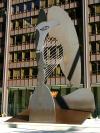
Pablo Ruiz Picasso (25 October 1881 – 8 April 1973) was a Spanish painter and sculptor who spent most of his adult life in France. One of the most influential artists of the 20th century, he is known for co-founding the Cubist movement, the invention of constructed sculpture, the co-invention of collage, and for the wide variety of styles that he helped develop and explore. Among his most famous works are the proto-Cubist Les Demoiselles d'Avignon (1907) and the anti-war painting Guernica (1937), a dramatic portrayal of the bombing of Guernica by German and Italian air forces during the Spanish Civil War. His career spanned more than 76 years, from his late teens to his death in 1973.
Beginning his formal training under his father José Ruiz y Blasco aged seven, Picasso demonstrated extraordinary artistic talent from a young age, painting in a naturalistic manner through his childhood and adolescence. During the first decade of the 20th century, his style changed as he experimented with different theories, techniques, and ideas. After 1906, the Fauvist work of the older artist Henri Matisse motivated Picasso to explore more radical styles, beginning a fruitful rivalry between the two artists, who subsequently were often paired by critics as the leaders of modern art.
Picasso's output, especially in his early career, is often periodized. While the names of many of his later periods are debated, the most commonly accepted periods in his work are the Blue Period (1901–1904), the Rose Period (1904–1906), the African-influenced Period (1907–1909), Analytic Cubism (1909–1912), and Synthetic Cubism (1912–1919), also referred to as the Crystal period. Much of Picasso's work of the late 1910s and early 1920s is in a neoclassical style, and his work in the mid-1920s often has characteristics of Surrealism. His later work often combines elements of his earlier styles.
Exceptionally prolific throughout the course of his long life, Picasso achieved universal renown and immense fortune for his revolutionary artistic accomplishments, and became one of the best-known figures in 20th-century art.
Read more...