Who dated Henry III of France?
Françoise Babou de La Bourdaisière dated Henry III of France from ? until ?.
La Belle Châteauneuf dated Henry III of France from ? until ?.
Veronica Franco dated Henry III of France from ? until ?. The age gap was 5 years, 5 months and 25 days.
Jeanne de Laval dated Henry III of France from ? until ?. The age gap was 2 years, 0 months and 6 days.
Henry III of France
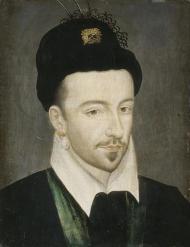
Henry III of France (French: Henri III, né Alexandre Édouard; 19 September 1551 – 2 August 1589) was King of France from 1574 until his assassination in 1589 and, as Henry of Valois (Polish: Henryk Walezy; Lithuanian: Henrikas Valua), King of Poland and Grand Duke of Lithuania from 1573 to 1575. Before he came to these thrones, he was known as the Duke of Angoulême and Duke of Orléans from 1560, then as Duke of Anjou from 1566.
As the fourth son of King Henry II of France and Queen Catherine de' Medici, he was not expected to inherit the French throne and thus was a good candidate for the vacant throne of the Polish–Lithuanian Commonwealth, where he was elected monarch in 1573. During his brief rule, he refused to sign the Henrician Articles into law, which would recognise the szlachta's right to freely elect their monarch. The Henrician Articles became, nonetheless, deeply rooted in Poland's politics as all his successors accepted them. Aged 22, Henry abandoned Poland–Lithuania upon inheriting the French throne when his brother, Charles IX of France, died without issue.
France was at the time plagued by the Wars of Religion, and Henry's authority was undermined by violent political factions funded by foreign powers: the Catholic League (supported by Spain and the Pope), the Protestant Huguenots (supported by England and the Dutch) and the Malcontents (led by Henry's own brother Francis, Duke of Anjou and Alençon, a party of Catholic and Protestant aristocrats who jointly opposed the absolutist ambitions of the king). Henry III was himself a politique, arguing that only a strong and centralised yet religiously tolerant monarchy would save France from collapse.
After the death of Henry's younger brother Francis, Duke of Anjou, and when it became apparent that Henry would not father an heir, the Wars of Religion developed into a dynastic war known as the War of the Three Henrys. Under Salic Law, Henry III's heir presumptive was his distant cousin, King Henry III of Navarre, a Protestant. The Catholic League, led by Henry I, Duke of Guise, demanded the exclusion of all Protestant heirs from the line of succession. They instead championed the Catholic Charles, Cardinal of Bourbon, as Henry III's heir presumptive.
Henry had the Duke of Guise murdered in 1588 and was in turn assassinated by Jacques Clément, a Catholic League fanatic, in 1589. He was succeeded by Henry of Navarre.
Read more...Françoise Babou de La Bourdaisière
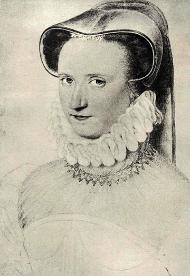
Françoise Babou de La Bourdaisière, Marquise of Coeuvres, vicomtess of Soissons and of Bercy (French pronunciation: [fʁɑ̃swaz babu də la buʁdezjɛʁ]; 1542 – 9 June 1592) was the mistress of a favourite of the king, Du Guast. She married Antoine d'Estrées in 1558, and they were the parents of Gabrielle d'Estrées—mistress of King Henry IV of France.
Read more...Henry III of France
La Belle Châteauneuf
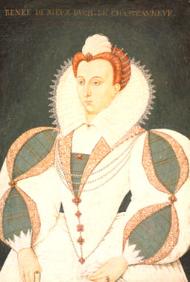
"La Belle Châteauneuf" (fl. 16th C.) was the name popularly given to Renée de Rieux, daughter of Jean de Rieux, seigneur de Châteauneuf, who was descended from one of the greatest families of Brittany. The dates of her birth and death are unknown.
Read more...Henry III of France
Veronica Franco

Veronica Franco ( - ) est une courtisane et poétesse renommée du XVIe siècle à Venise.
Read more...Henry III of France
Jeanne de Laval
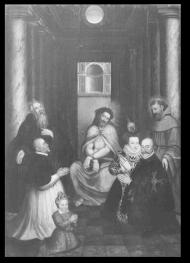
Jeanne de Laval (also Madame de Sennecterre) (1549–1586), was a French noblewoman. She was the mistress of Henry III of France. She was a lady-in-waiting to the queen, Louise of Lorraine.
Read more...