Who dated Katharine Hepburn?
Howard Hughes dated Katharine Hepburn from until . The age gap was 1 years, 4 months and 18 days.
Spencer Tracy dated Katharine Hepburn from until . The age gap was 7 years, 1 months and 7 days.
Katharine Hepburn

Katharine Houghton Hepburn (May 12, 1907 – June 29, 2003) was an American actress whose career as a leading lady on stage and screen spanned six decades. Known for her headstrong independence, spirited personality, and outspokenness, she cultivated a screen persona that matched this public image, and regularly played strong-willed, sophisticated women. She worked in a varied range of genres, from screwball comedy to literary drama. Her accolades include a record four Academy Awards for Best Actress, two British Academy Film Awards and a Primetime Emmy Award, in addition to nominations for two Tony Awards, two Grammy Awards and eight Golden Globe Awards.
Raised in Connecticut by progressive parents, Hepburn began to act while at Bryn Mawr College. Favorable reviews of her work on Broadway brought her to the attention of Hollywood. Her early years in film brought her international fame, including an Academy Award for Best Actress for her third film, Morning Glory (1933), but this was followed by a series of commercial failures culminating in the critically lauded box office failure Bringing Up Baby (1938).
Hepburn masterminded her comeback, buying out her contract with RKO Radio Pictures and acquiring the film rights to The Philadelphia Story, which she sold on the condition that she be the star. That comedy film was a box office success and landed her a third Academy Award nomination. In the 1940s, she was contracted to Metro-Goldwyn-Mayer, where her career focused on an alliance with Spencer Tracy. The screen partnership spanned 26 years and produced nine films.
Hepburn challenged herself in the latter half of her life as she tackled Shakespearean stage productions and a range of literary roles. She found a niche playing mature, independent, and sometimes unmarried or widowed women such as in The African Queen (1951), a persona the public embraced. Hepburn received three more Academy Awards for her performances in Guess Who's Coming to Dinner (1967), The Lion in Winter (1968), and On Golden Pond (1981). In the 1970s, she began appearing in television films, which later became her focus. She made her final screen appearance at the age of 87. After a period of inactivity and ill health, Hepburn died in 2003 at the age of 96.
Hepburn famously shunned the Hollywood publicity machine, and refused to conform to societal expectations of women. She was outspoken, assertive, athletic, and wore pants before it was fashionable. She married once, as a young woman, but thereafter lived independently. With her unconventional lifestyle and the independent characters she brought to the screen, Hepburn came to epitomize the "modern woman" in 20th-century America and influenced changing popular perceptions of women. In 1999, she was named the greatest female star of classic Hollywood cinema by the American Film Institute.
Read more...Howard Hughes
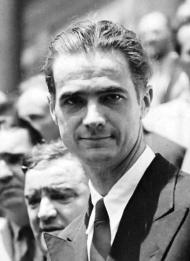
Howard Robard Hughes Jr. (Humble, Texas, 24 de diciembre de 1905-Houston, 5 de abril de 1976) fue un multimillonario empresario, magnate, inversionista, ingeniero autodidacta, aviador, productor y director de cine estadounidense, conocido por sus películas La horda (1928), Hermanos de armas (1930) y The Outlaw (1943). Igualmente se le reconoce por sus aportes a la aviación, introduciendo numerosas innovaciones en el diseño de aeronaves, tales como la construcción de aviones como el Hughes H-1 y el hidroavión Hughes H-4 Hercules, además de materializar muchas hazañas aéreas, incluyendo la obtención de varios récords de velocidad y extensión.
Hughes, además, alcanzó una gran notoriedad pública gracias a su férrea oposición al pseudo-monopolio de la icónica aerolínea estadounidense Pan Am, que disponía de la «Designación legal» para realizar exclusivamente vuelos transatlánticos en Estados Unidos, viéndose envuelto en una batalla política y legal que finalmente acabó con dicha legislación, permitiendo el inicio de operaciones en el área de su propia línea aérea, la Trans World Airlines, mediante sus aviones Lockheed Constellation.
Fue un personaje polémico por sus excentricidades, manías y su comportamiento lunático en general, que estuvo motivado en gran medida por padecer de un trastorno obsesivo-compulsivo (TOC); no obstante, su genialidad es indiscutible, y su legado notorio en todos los ámbitos en los que se desenvolvió. Su fallecimiento en 1976 fue igualmente controvertido; muy enfermo fue embarcado en un avión en México rumbo a Houston, pero no está claro si falleció antes de llegar.
Fue considerado el hombre más adinerado del mundo y el primero en llegar a tener 1000 millones de dólares, con una fortuna estimada en unos mil quinientos millones de dólares en el momento de su muerte. En 1983, tras años de disputas legales, su patrimonio, cotizado en unos 2500 millones de dólares, se dividió entre sus 22 primos, incluyendo a su primo William Lummis, que ejerció como fideicomisario del Instituto Médico Howard Hughes.
Read more...Katharine Hepburn
Spencer Tracy

Spencer Bonaventure Tracy (April 5, 1900 – June 10, 1967) was an American actor. He was known for his natural performing style and versatility. One of the major stars of Hollywood's Golden Age, Tracy was the first actor to win two consecutive Academy Awards for Best Actor, from nine nominations. During his career, he appeared in 75 films and developed a reputation among his peers as one of the screen's greatest actors. In 1999, the American Film Institute ranked Tracy as the ninth greatest male star of Classic Hollywood Cinema.
Tracy first discovered his talent for acting while attending Ripon College, and he later received a scholarship for the American Academy of Dramatic Arts. He spent seven years in the theater, working in a succession of stock companies and intermittently on Broadway. His breakthrough came in 1930, when his lead performance in The Last Mile caught the attention of Hollywood. After a successful film debut in John Ford's Up the River (in which he starred with Humphrey Bogart), he was signed to a contract with Fox Film Corporation. Tracy's five years with Fox featured one acting tour de force after another that were usually ignored at the box office, and he remained largely unknown to movie audiences after 25 films, nearly all of them starring him as the leading man. None of them were hits, although his performance in The Power and the Glory (1933) was highly praised at the time.
In 1935, Tracy joined Metro-Goldwyn-Mayer (MGM), Hollywood's most prestigious studio at the time. His career flourished after his fifth MGM film, Fury (1936), and in 1937 and 1938 he won consecutive Oscars for Captains Courageous and Boys Town. Tracy teamed with Clark Gable, MGM's most prominent leading man, for three major box office successes, and by the early 1940s, he was one of MGM's top stars. In 1942, he appeared with Katharine Hepburn in Woman of the Year, beginning a professional and personal partnership that led to nine films over 25 years. In 1955, Tracy won the Cannes Film Festival Award for Best Actor for his performance in the film Bad Day at Black Rock.
Tracy left MGM in 1955 and continued to work regularly as a freelance star, despite several health issues and an increasing weariness and irritability as he aged. His personal life was troubled, with a lifelong struggle against severe alcoholism and guilt over his son's deafness. Tracy and his wife Louise became estranged in the 1930s, but the couple never divorced. His 25-year relationship with Katharine Hepburn was an open secret. Towards the end of his life, Tracy worked almost exclusively for director Stanley Kramer. Tracy made his last film with Kramer, Guess Who's Coming to Dinner (1967), with filming completed just 17 days before he died.
Read more...