Who dated Margareta Slots?
Gustavus Adolphus of Sweden dated Margareta Slots from ? until ?.
Margareta Slots
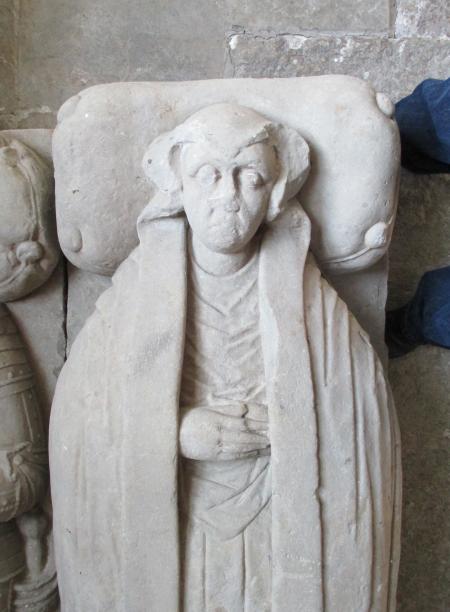
Margareta Slots or Margareta Cabiljau (died 1669) was the royal mistress of king Gustav II Adolf of Sweden and the mother of his illegitimate son Gustav of Vasaborg.
Margareta Slots was the daughter of the Dutch merchant Abraham Cabiljau and Maria van Leest. During the Ingrian War Slots met Gustav at the siege of Pskov in 1615. At the time she was married to the Dutch military engineer Andries Sessandes, who fell in battle at Pskov soon after (October 1615).
In 1616, she and Gustav had a son, Gustav Gustavson; Gustav acknowledged his son and granted him an allowance. Slots then married the paper maker Arendt Slots, who died a few years later, and then the petardist and "Feuerwerker" (artillerist and gunpowder maker) Jacob Trello (died 1632), and was given the estate Benhamra in Uppland, where she lived with her husbands, often asking for favours from the king.
In 1625, she was involved in an incident. The bailiff Jacob Galle threatened her with confiscation after she had prevented her tenants to take part in royal construction work. As a response she visited Galle, asked if he had not heard of the privileges granted her by the monarch, and struck him with her stick, after which Galle was beaten by her servants. Galle died of the injuries and she was accused for his murder, but no legal action against her is mentioned.
Reportedly, she met Gustav Adolph only once, in 1630, after their relationship had ended.
Read more...Gustavus Adolphus of Sweden
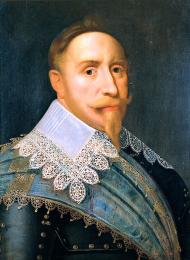
Gustavus Adolphus (9 December [N.S. 19 December] 1594 – 6 November [N.S. 16 November] 1632), also known as Gustav II Adolf or Gustav II Adolph, was King of Sweden from 1611 to 1632. He is credited with the rise of Sweden as a great European power (Swedish: Stormaktstiden). During his reign, Sweden became one of the primary military forces in Europe during the Thirty Years' War, helping to determine the political and religious balance of power in Europe. He was formally and posthumously given the name Gustavus Adolphus the Great (Swedish: Gustav Adolf den store; Latin: Gustavus Adolphus Magnus) by the Riksdag of the Estates in 1634.
He is often regarded as one of the greatest military commanders in modern history, with use of an early form of combined arms. His most notable military victory was the Battle of Breitenfeld in 1631. With his resources, logistics, and support, Gustavus Adolphus was positioned to become a major European leader, but he was killed a year later at the Battle of Lützen. He was assisted in his efforts by Count Axel Oxenstierna, the Lord High Chancellor of Sweden, who also acted as regent after his death.
Coming to the throne at the age of 16, Gustavus Adolphus inherited three wars from his father Charles IX of Sweden: conflicts with Russia and Denmark–Norway, and a dynastic struggle with his first cousin, King Sigismund III Vasa of Poland. Of these, the Danish war was the most serious. During his reign, Sweden rose from the status of a Baltic Sea basin regional power to one of the great powers of Europe and a model of early modern era government. Gustavus Adolphus is known as the "father of modern warfare", or the first modern general. Gustavus Adolphus was the main figure responsible for the success of Swedish arms during the Thirty Years' War and led his nation to great prestige. As a general, Gustavus Adolphus employed mobile artillery on the battlefield, as well as very aggressive tactics, where attack was stressed over defense, and mobility and cavalry initiative were emphasized. He taught a number of other military commanders, such as Lennart Torstensson, who would go on to expand the boundaries and power of the Swedish Empire after Gustavus Adolphus's death. Spoils meant he became a successful bookraider in Europe, targeting Jesuit library collections.
His contributions to Sweden's rise in power included reformation of the administrative structure. For example, he began Parish Registration of the population, so that the central government could more efficiently tax and conscript the people. He is also widely commemorated by Protestants in Europe as the main defender of their cause during the Thirty Years' War, with multiple churches, foundations and other undertakings named after him, including the Gustav-Adolf-Werk. His involvement in the Thirty Years' War gave rise to the nickname "the Lion from the North".
Read more...