Who dated Marie Anne de Coislin?
Gustav III of Sweden dated Marie Anne de Coislin from ? until ?. The age gap was 13 years, 4 months and 7 days.
Louis XV of France dated Marie Anne de Coislin from ? until ?. The age gap was 22 years, 7 months and 2 days.
Peter III of Russia dated Marie Anne de Coislin from ? until ?. The age gap was 4 years, 6 months and 27 days.
Marie Anne de Coislin
Marie-Anne de Mailly-Rubempré, marquise de Coislin ou Marie Anne de Coislin, est une aristocrate française et une maîtresse de Louis XV, née le et morte le à Paris.
Read more...Gustav III of Sweden
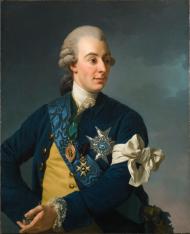
Gustav III (24 January [O.S. 13 January] 1746 – 29 March 1792), also called Gustavus III, was King of Sweden from 1771 until his assassination in 1792. He was the eldest son of King Adolf Frederick and Queen Louisa Ulrika of Sweden.
Gustav was a vocal opponent of what he saw as the abuse of political privileges seized by the nobility since the death of King Charles XII in the Great Northern War. Seizing power from the government in a coup d'état, called the Swedish Revolution, in 1772 that ended the Age of Liberty, he initiated a campaign to restore a measure of royal autocracy. This was completed by the Union and Security Act of 1789, which swept away most of the powers exercised by the Swedish Riksdag of the Estates during the Age of Liberty, but at the same time, it opened up the government for all citizens, thereby breaking the privileges of the nobility.
A believer in enlightened absolutism, Gustav spent considerable public funds on cultural ventures, which were controversial among his critics, as well as military attempts to seize Norway with Russian aid, then a series of attempts to re-capture the Swedish Baltic dominions lost during the Great Northern War through the failed war with Russia. Nonetheless, his successful leadership in the Battle of Svensksund averted a complete military defeat and signified that Swedish military might was to be countenanced after its major defeats earlier in the century.
An admirer of Voltaire, Gustav legalised Catholic and Jewish presence in Sweden, and enacted wide-ranging reforms aimed at economic liberalism, social reform and the restriction, in many cases, of torture and capital punishment. The much-praised Freedom of the Press Act of 1766 was severely curtailed, however, by amendments in 1774 and 1792, effectively extinguishing independent media. Following the uprising against the French monarchy in 1789, Gustav pursued an alliance of princes aimed at crushing the insurrection and re-instating his French counterpart, King Louis XVI, offering Swedish military assistance as well as his leadership.
In 1792, he was mortally wounded by a gunshot in the lower back during a masquerade ball as part of an aristocratic-parliamentary coup attempt, but managed to assume command and quell the uprising before succumbing to sepsis 13 days later, a period during which he received apologies from many of his political enemies. Gustav's immense powers were placed in the hands of a regency under his brother Prince Carl and Gustaf Adolf Reuterholm until his son and successor Gustav IV Adolf reached adulthood in 1796. The Gustavian autocracy thus survived until 1809, when his son was ousted in another coup d'état, which definitively established parliament as the dominant political power; this has lasted until the modern day, where the Riksdag is Sweden's supreme legislature.
A patron of the arts and benefactor of arts and literature, Gustav founded the Swedish Academy, created a national costume and had the Royal Swedish Opera and Royal Dramatic Theatre built. In 1772, he founded the Royal Order of Vasa to acknowledge and reward those Swedes who had contributed to advances in the fields of agriculture, mining and commerce. He was also a patron of many cultural figures, including Alexander Roslin and Carl Michael Bellman, and is often considered one of the most important figures in the history of Swedish art, music and architecture. Gustav III was well liked by the Swedish population and was mourned upon his death.
In 1777, Gustav III was the first formally neutral head of state in the world to recognise the United States during its war for independence from Great Britain. Swedish military forces were engaged by the thousands on the side of the colonists, largely through the French expedition force. Through the acquisition of Saint Barthélemy in 1784, Gustav enabled the restoration, if symbolic, of Swedish overseas colonies in America, as well as great personal profits from the transatlantic slave trade.
Read more...Marie Anne de Coislin
Louis XV of France
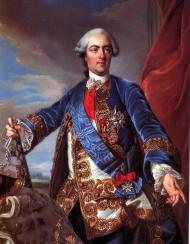
Louis XV (15 February 1710 – 10 May 1774), known as Louis the Beloved (French: le Bien-Aimé), was King of France from 1 September 1715 until his death in 1774. He succeeded his great-grandfather Louis XIV at the age of five. Until he reached maturity (then defined as his 13th birthday) in 1723, the kingdom was ruled by his grand-uncle Philippe II, Duke of Orléans, as Regent of France. Cardinal Fleury was chief minister from 1726 until his death in 1743, at which time the king took sole control of the kingdom.
His reign of almost 59 years (from 1715 to 1774) was the second longest in the history of France, exceeded only by his predecessor, Louis XIV, who had ruled for 72 years (from 1643 to 1715). In 1748, Louis returned the Austrian Netherlands, won at the Battle of Fontenoy of 1745. He ceded New France in North America to Great Britain and Spain at the conclusion of the disastrous Seven Years' War in 1763. He incorporated the territories of the Duchy of Lorraine and the Corsican Republic into the Kingdom of France. Historians generally criticize his reign and maintain that his incompetence and extravagance weakened France, depleted the treasury, discredited the absolute monarchy, and diminished the country's reputation internationally. However, a minority of scholars argue that he was popular during his lifetime, but that his reputation was later blackened by revolutionary propaganda. His grandson and successor Louis XVI inherited a kingdom on the brink of financial disaster and gravely in need of political reform, laying the groundwork for the French Revolution of 1789.
Read more...Marie Anne de Coislin
Peter III of Russia
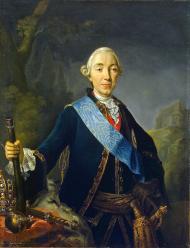
Peter III Fyodorovich (Russian: Пётр III Фёдорович, romanized: Pyotr III Fyodorovich, born Charles Peter Ulrich of Schleswig-Holstein-Gottorp; 21 February 1728 – 17 July 1762) was Emperor of Russia from 5 January 1762 until 9 July of the same year, when his wife, Catherine II, overthrew him in a palace coup d'état. He implemented many notable reforms during his reign, though he is criticised for undoing Russian gains in the Seven Years' War by forming an alliance with Prussia.
Peter was the son of Duke Charles Frederick of Holstein-Gottorp, and Grand Duchess Anna Petrovna of Russia, who died of puerperal fever after childbirth. After succeeding to the throne of Holstein-Gottorp following his father’s death, Peter was made heir presumptive to both the Russian and Swedish thrones in 1742. Due to his conversion to Russian Orthodoxy, he was disqualified from becoming King of Sweden.
Peter married his paternal second cousin, Princess Sophie of Anhalt-Zerbst, who took the Orthodox name of Catherine Alexeievna, in 1745. They had one child who survived to adulthood, Paul Petrovich. Peter succeeded his maternal aunt as Emperor of Russia in 1762. After a 186-day reign, Peter III was overthrown by his wife, and soon died under unclear circumstances. The official cause proposed by Catherine's new government was that he died due to hemorrhoids. This explanation was met with skepticism, both in Russia and abroad, with notable critics such as Voltaire and d'Alembert expressing doubt about the plausibility of death from such a condition.
After Peter III's death, many impostors thrived, pretending to be him, the most famous of whom were Yemelyan Pugachev and the "Montenegerin Tsar Peter III" (Stephan the Little).
Read more...