Who dated Prosper Mérimée?
George Sand dated Prosper Mérimée from ? until ?. The age gap was 0 years, 9 months and 3 days.
Prosper Mérimée
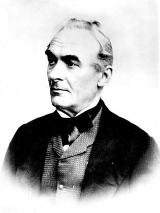
Prosper Mérimée (French: [pʁɔspɛʁ meʁime]; 28 September 1803 – 23 September 1870) was a French writer in the movement of Romanticism, one of the pioneers of the novella, a short novel or long short story. He was also a noted archaeologist and historian, an important figure in the history of architectural preservation. He is best known for his novella Carmen, which became the basis of Bizet's opera Carmen. He learned Russian, a language for which he had great affection, before translating the work of several notable Russian writers, including Pushkin and Gogol, into French. From 1830 until 1860 he was the inspector of French historical monuments, responsible for the protection of many historic sites, including the medieval citadel of Carcassonne and the restoration of the façade of the cathedral of Notre-Dame de Paris. Along with the writer George Sand, he discovered the series of tapestries called The Lady and the Unicorn, arranging for their preservation. He was instrumental in the creation of Musée national du Moyen Âge in Paris, where the tapestries now are displayed. The official database of French monuments, the Base Mérimée, bears his name.
Read more...George Sand
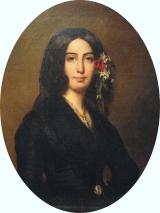
George Sand [ʒɔʁʒ sɑ̃d], nom de plume d'Aurore Dupin, par son mariage baronne Dudevant, est une romancière, dramaturge, épistolière, critique littéraire, journaliste et peintre française, née le à Paris et morte le au château de Nohant-Vic. Elle compte parmi les écrivains les plus prolifiques, avec plus de 70 romans à son actif et 50 volumes d'œuvres diverses dont des nouvelles, des contes, des pièces de théâtre et des textes politiques.
À l'image de son arrière-grand-mère, Louise Dupin, qu'elle admire, George Sand prend la défense des femmes, prône la passion, fustige le mariage et lutte contre les préjugés d'une société conservatrice.
George Sand a fait scandale par sa vie amoureuse agitée, par sa tenue vestimentaire masculine, dont elle a lancé la mode, par son pseudonyme masculin, qu'elle adopte dès , et dont elle lance aussi la mode : après elle, Marie d'Agoult signe ses écrits « Daniel Stern », Delphine de Girardin prend, en 1843, le nom de plume de « vicomte Charles de Launay ».
Malgré la misogynie de nombreux détracteurs comme Charles Baudelaire ou Jules Barbey d'Aurevilly, George Sand contribue activement à la vie intellectuelle de son époque, accueillant au domaine de Nohant ou à Palaiseau des personnalités aussi différentes que Franz Liszt, Frédéric Chopin, Marie d'Agoult, Honoré de Balzac, Gustave Flaubert, Eugène Delacroix, Henri Chapu, conseillant les uns, encourageant les autres. Elle a entretenu une importante correspondance avec Victor Hugo bien que ces deux grandes personnalités ne se soient jamais rencontrées.
Elle s'est aussi illustrée par un engagement politique actif à partir de , inspirant Alexandre Ledru-Rollin, participant au lancement de trois journaux : La Cause du peuple, Le Bulletin de la République, L'Éclaireur, plaidant auprès de Napoléon III la cause de condamnés, notamment celle de Victor Hugo dont elle admirait l'œuvre et dont elle a tenté d'obtenir la grâce après avoir éclipsé Notre-Dame de Paris avec Indiana, son premier roman.
Son œuvre est abondante et la campagne du Berry lui sert souvent de cadre. Ses premiers romans, comme Indiana (1832), bousculent les conventions sociales et magnifient la révolte des femmes en exposant les sentiments de ses contemporaines, chose exceptionnelle à l'époque et qui divisa aussi bien l'opinion publique que l'élite littéraire. Puis George Sand ouvre ses romans à la question sociale en défendant les ouvriers et les pauvres (Le Compagnon du Tour de France) et en imaginant une société sans classes et sans conflit (Mauprat, 1837 ; Le Meunier d'Angibault, 1845).
Elle se tourne ensuite vers le milieu paysan et écrit des romans champêtres idéalisés comme La Mare au diable (1846), François le Champi (1848), La Petite Fadette (1849), Les Maîtres sonneurs (1853).
George Sand a abordé d'autres genres comme l'autobiographie (Histoire de ma vie, 1855) et le roman historique avec Consuelo (1843) où elle brosse, à travers la figure d'une cantatrice italienne, le paysage artistique européen du XVIIIe siècle, ou encore Les Beaux Messieurs de Bois-Doré (1858) qui multiplie les péripéties amoureuses et aventureuses dans le contexte des oppositions religieuses sous le règne de Louis XIII. Vers la fin de sa vie, elle écrit une abondante œuvre théâtrale, restée largement inédite de son vivant.
Read more...