Who dated Sun Weishi?
Lin Biao dated Sun Weishi from ? until ?. The age gap was 12 years, 11 months and 25 days.
Sun Weishi

Sun Weishi (Chinese: 孙维世; 30 November 1921 – 15 October 1968) was the first female director of modern spoken drama (huaju) in Chinese history. Sun's father was killed by the Kuomintang (KMT) in 1927, and Sun was eventually adopted by Zhou Enlai, who later became the first premier of the People's Republic of China. While in Yan'an, Sun aroused the enmity of Mao's wife, Jiang Qing, beginning a rivalry between the two that lasted throughout Sun's life until her ultimate death at Jiang's hands. During World War II, Sun lived in Moscow, studying theater. Lin Biao was also in Moscow at the time and proposed to Sun before returning to China in 1942, but Sun rejected him. Lin married another woman, Ye Qun, in 1943. Ye held a lifelong grudge against Sun for her earlier relationship with Lin.
After the end of World War II, Sun returned to China and became active in acting and directing in Chinese theater. In 1950, shortly after the founding of the People's Republic of China, Sun was invited to become the director of the China Youth Art Theater, and married one of the most famous actors then in China the same year. Over the next several years Sun staged performances that were critically well-received, some of which became famous across China. In 1956, Sun became the artistic director and vice-president of the Chinese Experimental Theater.
When the Cultural Revolution occurred in 1966, Zhou Enlai sent Sun and her husband to work in Daqing to protect them from political persecution, but Jiang Qing and Ye Qun conspired to have Sun secretly arrested in 1968 while visiting Zhou Enlai in Beijing. Sun was sentenced without trial, and was tortured in a secret prison for several months before dying. After Sun died, Jiang Qing made arrangements for Sun's body to be cremated before an autopsy could be performed, and for her ashes to be disposed of before Zhou or Sun's other relatives could take possession of them. Sun's husband was not informed of Sun's death until his release, in 1975.
Read more...Lin Biao
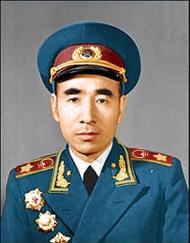
Lin Biao (Chinese: 林彪; 5 December 1907 – 13 September 1971) was a Chinese military commander and politician. Pivotal to the Communist victory in the Chinese Civil War, he commanded the Liaoshen and Pingjin campaigns at the head of the Manchurian Field Army, led the People's Liberation Army into Beijing, and swept the Kuomintang from the coastal provinces of Southeast China. He was ranked third among the Ten Marshals of the People's Republic of China, behind Zhu De and Peng Dehuai.
After 1949, Lin initially withdrew from active politics. He served as a Vice Premier from 1954 and as one of the Vice Chairmen of the Chinese Communist Party from 1958, before assuming the additional post of Minister of National Defense in 1959. In the early 1960s he played a key role in cultivating Mao Zedong's cult of personality, and was rewarded during the Cultural Revolution by being designated Mao's sole successor as the Party's only Vice Chairman, a position he held from 1966 until his death.
Lin died on 13 September 1971 when a Hawker Siddeley Trident crashed near Öndörkhaan, Mongolia, in circumstances that remain disputed. The official Chinese account of the "Lin Biao incident" holds that Lin and his family were fleeing after a failed coup attempt against Mao; others contend they fled fearing imminent purge. He was posthumously condemned as a traitor, and since the late 1970s has been officially grouped with Jiang Qing as one of the two principal "counter-revolutionary" forces held responsible for the worst excesses of the Cultural Revolution.
Read more...