Who dated Terry Moore (actress)?
Howard Hughes dated Terry Moore (actress) from until . The age gap was 23 years, 0 months and 14 days.
Terry Moore (actress)

Terry Moore (born Helen Luella Koford; January 7, 1929) is an American actress whose career has spanned more than eight decades. She began her career as a child performer in bit parts, notably appearing uncredited as the 14-year-old version of Ingrid Bergman’s character in Gaslight (1944). After signing with Columbia Pictures, Moore was loaned to RKO for Mighty Joe Young (1949), which brought her widespread recognition. She subsequently received an Academy Award nomination for Best Supporting Actress for her performance in Come Back, Little Sheba (1952). Beginning with Elia Kazan’s Man on a Tightrope (1953), Moore worked extensively at 20th Century-Fox throughout the 1950s, appearing in such films as Beneath the 12-Mile Reef (1953), King of the Khyber Rifles (1953), Daddy Long Legs (1955), Between Heaven and Hell (1956), and Peyton Place (1957).
Moore also worked extensively in television, including a regular role in the Western series Empire (1962–1963) and guest appearances on such programs as Bonanza, Batman, Burke’s Law, True Detective, and Ray Donovan. Moore gained notoriety when she claimed that she and billionaire Howard Hughes had been secretly married aboard a ship in 1949. The claim was disputed, and the marriage was never legally recognized, though she received a financial settlement from Hughes’s estate. Moore is one of the last surviving stars of the Golden Age of Hollywood.
Read more...Howard Hughes
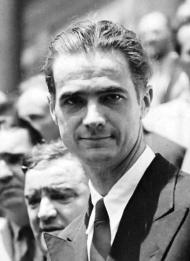
Howard Robard Hughes Jr. (December 24, 1905 – April 5, 1976) was an American aviator, aerospace engineer, business magnate, film producer, and investor. He was one of the richest and most influential people in the world during his lifetime. He first became prominent as a film producer, and then as an important figure in the aviation industry. Later in life, he became known for his eccentric behavior and reclusive lifestyle—oddities that were caused in part by his worsening obsessive–compulsive disorder (OCD), chronic pain from a near-fatal plane crash, and increasing deafness.
As a film tycoon, Hughes gained fame in Hollywood beginning in the late 1920s, when he produced big-budget and often controversial films such as The Racket (1928), Hell's Angels (1930), and Scarface (1932). He later acquired the RKO Pictures film studio in 1948, recognized then as one of the Big Five studios in Hollywood, although the production company struggled under his control and ultimately ceased operations in 1957.
In 1932, Hughes founded Hughes Aircraft Company and spent the next two decades setting multiple world air speed records and building landmark planes like the Hughes H-1 Racer (1935) and the H-4 Hercules (the Spruce Goose, 1947). The H-4 was the largest flying boat in history with the longest wingspan of any aircraft from the time it was built until 2019. He acquired and expanded Trans World Airlines and later acquired Air West, renaming it Hughes Airwest. Hughes won the Harmon Trophy on two occasions (1936 and 1938), the Collier Trophy (1938), and the Congressional Gold Medal (1939) all for his achievements in aviation throughout the 1930s. He was inducted into the National Aviation Hall of Fame in 1973 and was included in Flying magazine's 2013 list of the 51 Heroes of Aviation, ranked at No. 25.
During his final years, Hughes extended his financial empire to include several major businesses in Las Vegas, such as real estate, hotels, casinos, and media outlets. Known at the time as one of the most powerful men in the state of Nevada, he is largely credited with transforming Las Vegas into a more refined cosmopolitan city. After years of mental and physical decline, Hughes died of kidney failure in 1976. His legacy is maintained through the Howard Hughes Medical Institute and Howard Hughes Holdings Inc.
Read more...