Who dated Sally Hemings?
Thomas Jefferson dated Sally Hemings from ? until ?.
Sally Hemings
Sally Hemings, whose given name may have been Sarah, (c. 1773 – 1835) was an enslaved woman, inherited among many others by the third President of the United States Thomas Jefferson, from his father-in-law, John Wayles. Her mother was Elizabeth "Betty" Hemings. Hemings's father was John Wayles, the enslaver of Elizabeth Hemings who owned her from the time of her birth. Wayles was also the father of Jefferson's wife, Martha, making Hemings the half-sister to Jefferson's wife.
Hemings's maternal grandmother was an enslaved African woman whose name is not recorded. Hemings's maternal grandfather was John Hemings, an English captain. Therefore, Hemings was of 3/4 European and 1/4 African descent, making her a quadroon according to contemporary American racial classification. This also means Hemings was the third generation of women in her family to be impregnated by a free man during her enslavement and the second to be impregnated by the man she was enslaved to.
Martha Jefferson died during her marriage to Thomas Jefferson in 1782. In 1787, at 14, Hemings accompanied Jefferson's daughter to Paris where they joined Thomas Jefferson. In Paris, Hemings was legally free, as slavery was not legal in France. At some time during her 26 months in Paris, Jefferson is believed to have begun intimate relations with her. As attested by her son, Madison Hemings, Sally agreed with Jefferson that she would return to Virginia and resume her life in slavery, as long as all their children would be freed when they came of age.
Multiple lines of evidence, including modern DNA analyses, indicate that at least one member of the Jefferson family fathered at least six children with Hemings over the course of several decades at Jefferson's Monticello estate. Historians broadly agree that Jefferson was the father. Jefferson is purported to have begun sexual relations with Hemings when she was an adolescent, likely when she was between the ages of 14 and 16, while he was in his mid-40s and exercised near total legal, economic, and physical control over her life. Under these conditions, meaningful consent was impossible. As an enslaved person, Hemings would not have been able to refuse sexual access without risk of punishment, sale, or violence, and any absence of recorded force reflects the structural secrecy and power imbalance inherent in slavery rather than evidence of voluntariness. Many historians and scholars therefore describe Jefferson’s actions as sexual exploitation or rape within chattel slavery. Four of Hemings' children survived into adulthood and were freed by Jefferson or his will as they came of age. Hemings died in Charlottesville, Virginia, in 1835 in the home of her freed sons.
The historical question of whether Jefferson was the father of Hemings' children is the subject of the Jefferson–Hemings controversy. Following renewed historical analysis in the late 20th century, the Thomas Jefferson Foundation, an organization which has owned Monticello since 1923 and is dedicated to preserving and educating on Jefferson’s legacy, empaneled a commission of scholars and scientists to investigate the parentage of Hemings’s children. The Foundation panel worked with a 1998–1999 genealogical DNA test and found a match between the Jefferson male line and a descendant of Hemings's youngest son, Eston Hemings. The Foundation panel concluded that Jefferson fathered Eston and likely Hemings’s other five children as well. In response to this finding, as well as to the growing historical consensus that Jefferson fathered Hemings's children, critics founded Thomas Jefferson Heritage Society. The Society commissioned another panel of scholars in 2001, which concluded that it had not been proven that Thomas Jefferson fathered Sally Hemings' children. The Society’s panel acknowledged that Jefferson may have fathered Hemings's children, but concluded that Randolph Jefferson or his sons may have also been the father. In 2018, the Thomas Jefferson Foundation of Monticello announced its plans to have an exhibit titled Life of Sally Hemings, and affirmed that it was treating as a settled issue that Jefferson was the father of her known children.
Read more...Thomas Jefferson
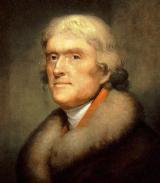
Thomas Jefferson (April 13 [O.S. April 2], 1743 – July 4, 1826) was an American Founding Father and the third president of the United States from 1801 to 1809. He was the primary author of the Declaration of Independence. Jefferson was the nation's first U.S. secretary of state under George Washington and then the nation's second vice president under John Adams. Jefferson was a leading proponent of democracy, republicanism, and natural rights, and he produced formative documents and decisions at the state, national, and international levels.
Jefferson was born into the Colony of Virginia's planter class, dependent on slave labor. During the American Revolution, Jefferson represented Virginia in the Second Continental Congress, which unanimously adopted the Declaration of Independence. Jefferson's advocacy for individual rights, including freedom of thought, speech, and religion, helped shape the ideological foundations of the revolution. This inspired the Thirteen Colonies in their revolutionary fight for independence, which culminated in the establishment of the United States as a free and sovereign nation.
Jefferson served as the second governor of revolutionary Virginia from 1779 to 1781. In 1785, Congress appointed Jefferson as U.S. Minister to France, where he served from 1785 to 1789. President Washington then appointed Jefferson the nation's first secretary of state, where he served from 1790 to 1793. In 1792, Jefferson and political ally James Madison organized the Democratic-Republican Party to oppose the Federalist Party during the formation of the nation's First Party System. Jefferson and Federalist John Adams became both personal friends and political rivals. In the 1796 U.S. presidential election between the two, Jefferson came in second, which made him Adams' vice president under the electoral laws of the time. Four years later, in the 1800 presidential election, Jefferson again challenged Adams and won the presidency. In 1804, Jefferson was reelected overwhelmingly to a second term, crushing his main opposition, the Federalist's Charles Cotesworth Pinckney of South Carolina.
Jefferson's presidency assertively defended the nation's shipping and trade interests against Barbary pirates and aggressive British trade policies, promoted a western expansionist policy with the Louisiana Purchase, which doubled the nation's geographic size, and reduced military forces and expenditures following successful negotiations with France. In his second presidential term, Jefferson was beset by difficulties at home, including the trial of his former vice president Aaron Burr. In 1807, Jefferson implemented the Embargo Act to defend the nation's industries from British threats to U.S. shipping, limit foreign trade, and stimulate the birth of the American manufacturing.
Jefferson is ranked among the upper tier of U.S. presidents both by scholars and in public opinion. Presidential scholars and historians have praised Jefferson's advocacy of religious freedom and tolerance, his peaceful acquisition of the Louisiana Territory from France, and his leadership in supporting the Lewis and Clark Expedition. They acknowledge his lifelong ownership of large numbers of slaves, but offer varying interpretations of his views on and relationship with slavery.
Read more...