Who dated Stanislas II?
Elżbieta Szydłowska dated Stanislas II from ? until ?.
Magdalena Agnieszka Sapieżyna dated Stanislas II from ? until ?.
Catherine II of Russia dated Stanislas II from ? until ?. The age gap was 2 years, 8 months and 15 days.
Izabela Czartoryska dated Stanislas II from ? until ?. The age gap was 14 years, 1 months and 14 days.
Stanislas II
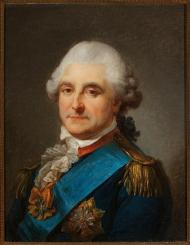
Stanislas II (en polonais : Stanisław August), de son vrai nom Stanisław Antoni Poniatowski, né le à Wołczyn (actuelle Biélorussie) et mort le à Saint-Pétersbourg, est, de 1764 à 1795, le dernier roi de Pologne et grand-duc de Lituanie, à l'époque de la République des Deux Nations.
Selon la titulature officielle, il est « par la grâce de Dieu et la volonté du peuple, roi de Pologne, grand-duc de Lituanie et duc de Ruthénie, Prusse, Mazovie, Samogitie, Kiev, Volhynie, Podolie, Podlasie, Livonie, Smolensk, Siewierz et Czernihów. »
Son règne a connu bien des vicissitudes. En 1762, son ancienne maîtresse, la princesse russe d'origine allemande Catherine, née Sophie Frédérique Augusta d'Anhalt-Zerbst, devient impératrice de Russie sous le nom de Catherine II. En 1764, après la mort d'Auguste III, Poniatowski est élu roi de Pologne en tant que candidat de la Russie et de la famille Czartoryski, qui est favorable à l'alliance étroite de la Pologne avec la Russie. Celle-ci, secondée par la Prusse, joue un rôle important au début du règne de Stanislas II, par le biais de son ambassadeur à Varsovie Nicolas Repnine.
La révolte d'une partie de la noblesse hostile à la Russie, liguée dans la confédération de Bar (1768-1772), aboutit au premier partage de la Pologne (1772). Stanislas II, maintenu sur le trône du fait de la défaite des confédérés, s'efforce alors de promouvoir un certain nombre de réformes, dont on peut citer la création de la Commission de l'Éducation nationale (1773), dans la limite de ce que son protecteur russe peut accepter.
Mais à la fin des années 1780, le mouvement de réforme prend une telle ampleur, à l'époque de la Grande Diète (1788-1792), qu'elle suscite l'hostilité de la Russie, dirigée par Catherine II jusqu'en 1796 : la promulgation de la Constitution du , la première en Europe, est l'origine directe de la guerre russo-polonaise de 1792, dont la suite est le deuxième partage de la Pologne (1793) et la soumission de Stanislas au parti pro-russe de la confédération de Targowica. En 1794, Stanislas apporte toutefois un certain soutien à l'insurrection dirigée par Tadeusz Kościuszko contre la Russie. Sa défaite aboutit au troisième partage de la Pologne en 1795 : privée de la totalité de son territoire, la république des Deux Nations cesse d'exister et Stanislas est contraint d'abdiquer, pour aller finir sa vie à Saint-Pétersbourg, au début du règne de Paul Ier.
Read more...Elżbieta Szydłowska
Elżbieta Szydłowska, married surname Grabowska (1748 – 1 June 1810), was a member of the Polish nobility, a mistress and possibly the morganatic wife of the last King of Poland, Stanisław August Poniatowski.
Read more...Stanislas II
Magdalena Agnieszka Sapieżyna
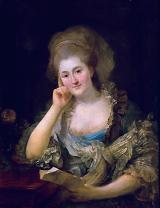
Magdalena Agnieszka Sapieżyna (1739-1780), was a Polish aristocrat. She was known as the mistress of King Stanisław August Poniatowski and had a child with him, Michał Cichocki, in 1770.
Read more...Stanislas II
Catherine II of Russia
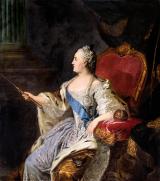
Catherine II (born Princess Sophia Augusta Frederica of Anhalt-Zerbst; 2 May 1729 – 17 November 1796), commonly known as Catherine the Great, was the reigning Empress of Russia from 1762 to 1796. She came to power after a coup d'etat against her husband, Peter III. Her long reign helped Russia thrive under a golden age during the Enlightenment. This renaissance led to the founding of many new cities, universities, and theatres, along with large-scale immigration from the rest of Europe and the recognition of Russia as one of the great powers of Europe.
After overthrowing and possibly assassinating her husband and her subsequent rule of the Russian Empire, Catherine often relied on noble favourites such as Count Grigory Orlov and Grigory Potemkin. Assisted by highly successful generals such as Alexander Suvorov and Pyotr Rumyantsev and admirals such as Samuel Greig and Fyodor Ushakov, she governed at a time when the Russian Empire was expanding rapidly by conquest and diplomacy. In the west, she installed her former lover to the throne of Poland, which was eventually partitioned. In the south, the Crimean Khanate was annexed following victories over the Bar Confederation and the Ottoman Empire in the Russo-Turkish War. With the support of Great Britain, Russia colonised the territories of New Russia along the coasts of the Black and Azov seas. In the east, Russians became the first Europeans to colonise Alaska, establishing Russian America.
Many cities and towns were founded on Catherine's orders in the newly conquered lands, most notably Yekaterinoslav, Kherson, Nikolayev, and Sevastopol. An admirer of Peter the Great, Catherine continued to modernise Russia along Western European culture. However, military conscription and the economy continued to depend on serfdom, and the increasing demands of the state and of private landowners intensified the exploitation of serf labour. This was one of the chief reasons behind rebellions, including Pugachev's Rebellion of Cossacks, nomads, peoples of the Volga, and peasants.
The Manifesto on Freedom of the Nobility, issued during the short reign of Peter III and confirmed by Catherine, freed Russian nobles from compulsory military or state service. The construction of many mansions of the nobility in the classical style endorsed by the empress changed the face of the country. She is often included in the ranks of the enlightened despots. Catherine presided over the age of the Russian Enlightenment and established the Smolny Institute of Noble Maidens, the first state-financed higher education institution for women in Europe.
Read more...Stanislas II
Izabela Czartoryska
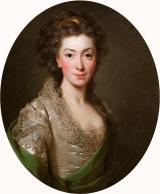
Izabela Czartoryska, née Flemming le à Varsovie, et morte le à Wysocko, est une princesse polonaise, salonnière, écrivain, mécène, collectionneuse d'œuvres d'art, créatrice des jardins anglais à Powązki et Puławy, fondatrice du premier musée en Pologne.
Read more...