Who dated Charles II of England?
Margaret de Carteret dated Charles II of England from ? until ?.
Hortense Mancini dated Charles II of England from ? until ?. The age gap was 15 years, 11 months and 29 days.
Lady Elizabeth Jones dated Charles II of England from ? until ?.
Catherine Pegge dated Charles II of England from ? until ?.
Moll Davis dated Charles II of England from ? until ?.
Frances Stewart, Duchess of Richmond dated Charles II of England from ? until ?. The age gap was 17 years, 1 months and 10 days.
Winifred Wells dated Charles II of England from ? until ?.
Jane Middleton dated Charles II of England from ? until ?. The age gap was 31 years, 6 months and 13 days.
Nell Gwyn dated Charles II of England from ? until ?. The age gap was 19 years, 7 months and 25 days.
Elizabeth Killigrew, Viscountess Shannon dated Charles II of England from ? until ?.
Louise de Keroual, Duchess of Portsmouth dated Charles II of England from ? until ?. The age gap was 19 years, 2 months and 29 days.
Lucy Walter dated Charles II of England from ? until ?.
Barbara Palmer, 1st Duchess of Cleveland dated Charles II of England from until . The age gap was 10 years, 5 months and 19 days.
Charles II of England
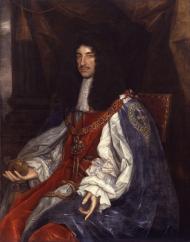
Charles II (29 May 1630 – 6 February 1685) was King of Scotland from 1649 until 1651 and King of England, Scotland, and Ireland from the 1660 Restoration of the monarchy until his death in 1685.
Charles II was the eldest surviving child of Charles I of England, Scotland and Ireland and Henrietta Maria of France. After Charles I's execution at Whitehall on 30 January 1649, at the climax of the English Civil War, the Parliament of Scotland proclaimed Charles II king on 5 February 1649. However, England entered the period known as the English Interregnum or the English Commonwealth with a republican government eventually led by Oliver Cromwell. Cromwell defeated Charles II at the Battle of Worcester on 3 September 1651, and Charles fled to mainland Europe. Cromwell became Lord Protector of England, Scotland and Ireland. Charles spent the next nine years in exile in France, the Dutch Republic and the Spanish Netherlands. A political crisis after Cromwell's death in 1658 resulted in the restoration of the monarchy in 1660, and Charles was invited to return to Britain. On 29 May 1660, his 30th birthday, he was received in London to public acclaim.
Charles's English Parliament enacted the Clarendon Code, to shore up the position of the re-established Church of England. Charles acquiesced to these new laws even though he favoured a policy of religious tolerance. The major foreign policy issue of his early reign was the Second Anglo-Dutch War. In 1670, he entered into the Treaty of Dover, an alliance with his cousin, King Louis XIV of France. Louis agreed to aid him in the Third Anglo-Dutch War and pay him a pension, and Charles secretly promised to convert to Catholicism at an unspecified future date. Charles attempted to introduce religious freedom for Catholics and Protestant dissenters with his 1672 Royal Declaration of Indulgence, but the English Parliament forced him to withdraw it. In 1679, Titus Oates's fabrication of a supposed Popish Plot sparked the Exclusion Crisis when it was revealed that Charles's brother and heir presumptive, James, Duke of York, had become a Catholic. The crisis saw the birth of the pro-exclusion Whig and anti-exclusion Tory parties. Charles sided with the Tories and, after the discovery of the Rye House Plot to murder Charles and James in 1683, some Whig leaders were executed or forced into exile. Charles dissolved the English Parliament in 1681 and ruled alone until his death in 1685.
A patron of the arts and sciences, Charles became known for his affability and friendliness, and for allowing his subjects easy access to his person. But he also showed an almost impenetrable reserve, especially concerning his political agendas. His court gained a reputation for moral laxity. Charles's marriage to Catherine of Braganza produced no surviving children, but the king acknowledged at least 12 illegitimate children by various mistresses. He was succeeded by his brother James.
Read more...Margaret de Carteret
Charles II of England
Hortense Mancini
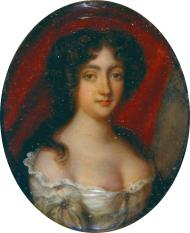
Hortense Mancini, Duchess of Mazarin (6 June 1646 – 2 July 1699), was a niece of Cardinal Mazarin, chief minister of France, and a mistress of Charles II, King of England, Scotland, and Ireland. She was the fourth of the five famous Mancini sisters, who, along with two of their female Martinozzi cousins, were known at the court of King Louis XIV of France as the Mazarinettes.
Read more...Charles II of England
Lady Elizabeth Jones
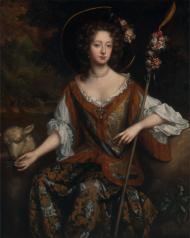
Charles II of England
Catherine Pegge
Catherine Pegge (1635 circa – ...) fu per lunghi anni amante del re d'Inghilterra Carlo II.
Dal sovrano ebbe due figli, Charles FitzCharles, I conte di Plymouth e Catherine FitzCharles.
Figlia di esponenti di classi sociali elevate, seguì la famiglia nell'esilio presso la città belga di Bruges e fu proprio in questa città che iniziò la sua relazione con il sovrano.
Read more...Charles II of England
Moll Davis
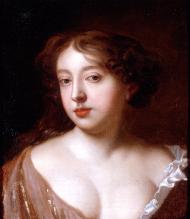
Mary "Moll" Davis (c. 1648 – 1708), also spelt Davies or Davys, was a courtesan and mistress of King Charles II of England. She was an actress and entertainer before and during her role as royal mistress.
Read more...Charles II of England
Frances Stewart, Duchess of Richmond
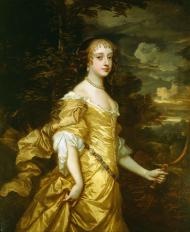
Frances Teresa Stewart, Duchess of Richmond and Lennox (8 July 1647 – 15 October 1702) was a prominent member of the Court of the Restoration and famous for refusing to become a mistress of Charles II of England. For her great beauty she was known as La Belle Stuart and served as the model for an idealised, female Britannia. She is one of the Windsor Beauties painted by Sir Peter Lely.
Read more...Charles II of England
Winifred Wells
Winifred Wells was a courtier at the Stuart Restoration court as a Maid of Honour to Queen consort Catherine of Braganza. She was also one of the many mistresses of King Charles II of England. Samuel Pepys refers to her as the King's mistress in his diary, and she also features in Philibert de Gramont's famous Mémoirs.
Read more...Charles II of England
Jane Middleton
Charles II of England
Nell Gwyn
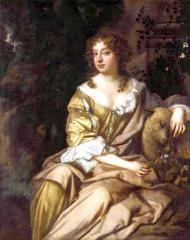
Eleanor Gwyn (also spelled Gwynn, Gwynne, Gwin; 2 February 1650 – 14 November 1687) was an English stage actress and celebrity figure of the Restoration period. Praised by Samuel Pepys for her comic performances as one of the first actresses on the English stage, she became best known for being a longtime mistress of King Charles II of England.
Called "pretty, witty Nell" by Pepys, she has been regarded as a living embodiment of the spirit of Restoration England, and has come to be considered a folk heroine, with a story echoing the rags-to-royalty tale of Cinderella. Gwyn had two sons by King Charles: Charles Beauclerk (1670–1726) and James Beauclerk (1671–1680). Charles Beauclerk was created Earl of Burford and Duke of St Albans; Murray Beauclerk, 14th Duke of St Albans is her descendant, and the current holder of the title.
Read more...Charles II of England
Elizabeth Killigrew, Viscountess Shannon
Elizabeth Boyle, Viscountess Shannon (born Elizabeth Killigrew; baptised 16 May 1622 – December 1680), was an English courtier and mistress of King Charles II.
Read more...Charles II of England
Louise de Keroual, Duchess of Portsmouth
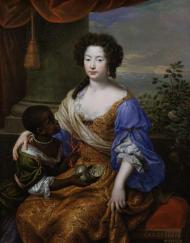
Louise Renée de Penancoët de Kérouaille, Duchess of Portsmouth (5 September 1649 – 14 November 1734) was a French mistress of King Charles II of England. She was also made Duchess of Aubigny in the peerage of France.
Read more...Charles II of England
Lucy Walter
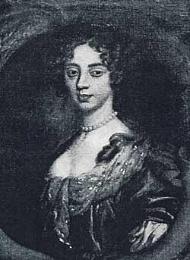
Lucy Walter (c. 1630 – 1658), also known as Lucy Barlow, was the first mistress of King Charles II of England and mother of James, Duke of Monmouth. During the Exclusion Crisis, a Protestant faction wanted to make her son heir to the throne, fuelled by the rumour that the king might have married Lucy, a claim which he denied.
Read more...Charles II of England
Barbara Palmer, 1st Duchess of Cleveland
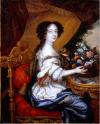
Barbara Palmer, 1st Duchess of Cleveland, Countess of Castlemaine (née Barbara Villiers VIL-ərz; 27 November [O.S. 17 November] 1640 – 9 October 1709), was an English royal mistress of the Villiers family and perhaps the most notorious of the many mistresses of King Charles II of England, by whom she had five children, all of them acknowledged and subsequently ennobled. Barbara was the subject of many portraits, in particular by court painter Sir Peter Lely.
Barbara's first cousin, Elizabeth Villiers (later 1st Countess of Orkney 1657–1733), was the presumed mistress of King William III. King William was the King of England, Scotland, and Ireland from 1689 to 1702.
Read more...